Applying SSbD at an early stage of chemical and materials development presents a fundamental methodological problem: decisions should already consider environmental impacts when reliable process and life-cycle data are often still scarce.
This challenge is addressed by Gustavo Larrea-Gallegos and Antonino Marvuglia of the Luxembourg Institute of Science and Technology (LIST) in their chapter “Integrating Large Language Models into the In-Silico Environmental Assessment of New Chemicals and Materials for SSbD”, published in the 2026 book ‘Life Cycle Management from Global to Local’. The work investigates how Large Language Models (LLMs), machine learning and existing Life Cycle Assessment (LCA) knowledge can be combined to generate preliminary Life Cycle Inventory (LCI) information for chemicals at early stages of development.
“Conducting such a type of assessment at early stages of the design process is far from trivial due to the lack of data or the need of lengthy modelling pipelines.”
From a chemical idea to a preliminary Life Cycle Inventory
At the centre of the study is ChemLCI, a prototype designed as a Rapid Inventory Modelling tool. Rather than attempting to provide a definitive environmental assessment, ChemLCI generates an initial, structured LCI that can serve as a starting point for subsequent and more detailed LCA modelling. Its architecture combines several computational approaches. A central LLM-based “conductor” interprets information supplied by the user and coordinates specialised services. These can identify the chemical structure, search existing Ecoinvent knowledge, predict possible synthesis routes and generate a structured LCI template. The architecture shown in the following figure illustrates how these components interact within the multi-agent system.
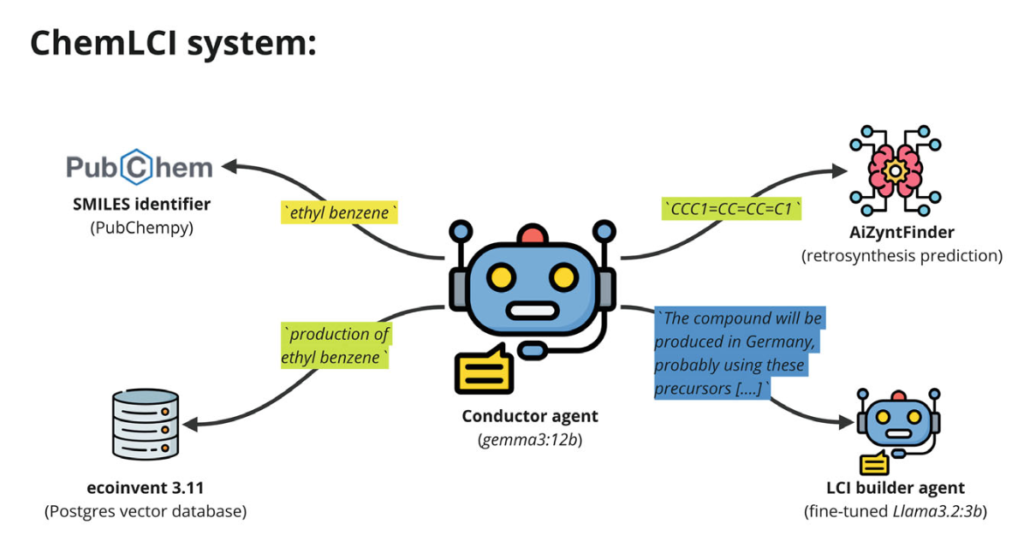
Figure: Schematic representation of the ChemLCI System (taken from the book chapter)
“ChemLCI is a RIM tool that serves as a bridge between the identification of a novel chemical candidate and the beginning of the iterative LCI modelling process.”
An important feature is the ability to process semantic, unstructured information supplied by researchers. This can make existing environmental knowledge accessible at a point in development when a conventional LCA would often lack sufficient input data.
The study is equally clear about current limitations. Tests showed that the LLM can generate plausible structured inventories, but results are not always consistent and may contain incorrect or invented inputs. Numerical estimation is another important weakness. ChemLCI should therefore be understood as a tool for rapidly drafting and exploring preliminary inventories, not as a substitute for validated LCA modelling.
“Their potential relies on the fast prototyping rather than the precise prediction.”
The scientific connection to PINK is direct. One of the project’s central ambitions is to develop integrated computational approaches that make SSbD applicable during innovation, including situations where relevant data are heterogeneous, distributed or incomplete. ChemLCI addresses precisely this early-stage information gap on the environmental sustainability side of SSbD. By combining existing LCA knowledge, molecular information, predictive methods and LLM-based processing, the approach demonstrates how computational tools could provide researchers with preliminary information before comprehensive experimental and process data become available. This also illustrates a broader PINK principle: computational methods are most valuable for SSbD not simply when they produce more data, but when they make existing knowledge accessible and actionable at the point where design decisions are being made. ChemLCI remains a prototype, and the chapter explicitly identifies validation, numerical accuracy and reliability as areas requiring further development. Nevertheless, the work demonstrates the potential of agentic AI to accelerate the construction of preliminary environmental inventories and thereby support more iterative, forward-looking LCA.
“Providing the user with means to introduce non-structured knowledge, such as semantic descriptions, can facilitate the exploration of different production plans or setups and support the SSbD adoption in chemical design.”
Scientific work was supported by the PINK project (Grant Agreement No. 101137809) and received funding from the European Union’s Horizon Europe Research and Innovation Programme. If you are interested read the full chapter here.