Developing safer and more sustainable nano/advanced materials increasingly depends on data. But having large amounts of data available is not enough: they must also be reliable and understandable to be re-used.
This challenge is at the centre of the position paper “Challenges and Future Directions in Assessing the Quality and Completeness of Advanced Materials Safety Data for Re-Usability”, published in Advanced Sustainable Systems by Verónica I. Dumit and a large interdisciplinary group of researchers from the European nanosafety and advanced materials community. And they are also involved in the PINK project: Penny Nymark (KI), Antreas Afantitis and Anastasios Papadiamantis (both from NovaM), Anna Costa (CNR), Steffi Friedrichs (AIST), Thomas Exner (7P9), Martin Himly (PLUS), and Iseult Lynch (UoB).
FAIR does not automatically mean fit for purpose
A central message of the paper is deceptively simple: FAIR data are not necessarily high-quality data. While the FAIR principles – Findable, Accessible, Interoperable and Re-usable – provide an essential foundation for research data infrastructures, they do not establish whether a dataset is scientifically reliable, sufficiently complete or appropriate for a particular application.
“While the FAIR […] principles aim to promote data re-use, they do not explicitly address the critical aspect of data quality.”
The paper therefore distinguishes between data quality, completeness and transferability. Importantly, what constitutes “complete” data depends on their intended use. Data suitable for exploratory research, for example, may not provide everything required for regulatory assessment.
“Only quality-assessed and complete […] data are efficiently transferable.”
From nanosafety experience to automated data re-use
Nanomaterials provide an important test case. More than a decade of nanosafety research has produced extensive experimental and computational data alongside new approaches for documenting, assessing and sharing them. Drawing on this experience, the publication reviews reporting standards, databases and quality-assessment approaches and concludes that context matters: different data types and applications require different quality criteria.
The practical challenge is equally important. Determining whether datasets contain sufficient metadata and meet defined quality criteria can require considerable manual effort.
“Data quality assessment remains a labor-intensive process, especially when performed manually.”
One important way forward is therefore greater automation. Machine-readable metadata, semantic data models, standardised reporting and automated quality assessment can support more efficient data re-use – particularly for computational modelling and AI.
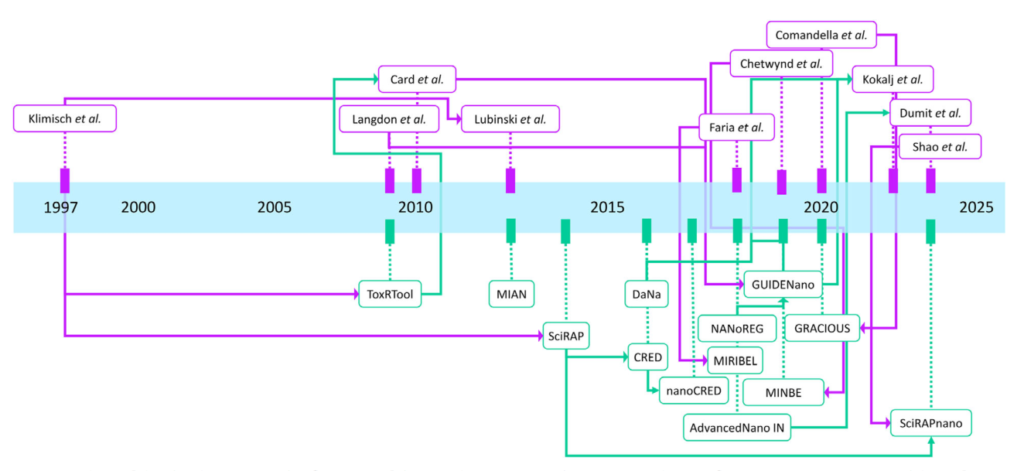
Schematic figure showing the timeline of the development and refinement of data quality criteria and nanomaterials-specific minimum reporting guidelines for various aspects of safety assessment (source: publication)
Connecting data quality, SSbD and PINK
These questions are directly relevant to Safe-and-Sustainable-by-Design (SSbD), which requires diverse information on functionality, material properties, safety, exposure and sustainability to inform decisions throughout the innovation process.
“The SSbD framework requires the integration of safety and sustainability from the earliest stages of innovation.”
This also provides a direct connection to PINK, one of the Horizon Europe projects contributing to the joint work described in the publication. PINK’s work on FAIR data, semantic interoperability, data quality and computational approaches for SSbD addresses the same fundamental challenge: transforming heterogeneous materials and safety data into trustworthy knowledge for decision-making.
The paper therefore reinforces an important principle behind PINK: the value of data does not end when an experiment is completed. With appropriate metadata, quality assessment and digital infrastructure, today’s research data can become a trusted resource for tomorrow’s modelling, safety assessment and sustainable materials innovation.
If you are interested in the full publication follow this link to read online.
The PINK project is funded by the European Union`s R&I Programme Horizon Europe (grant agreement # 101137809).