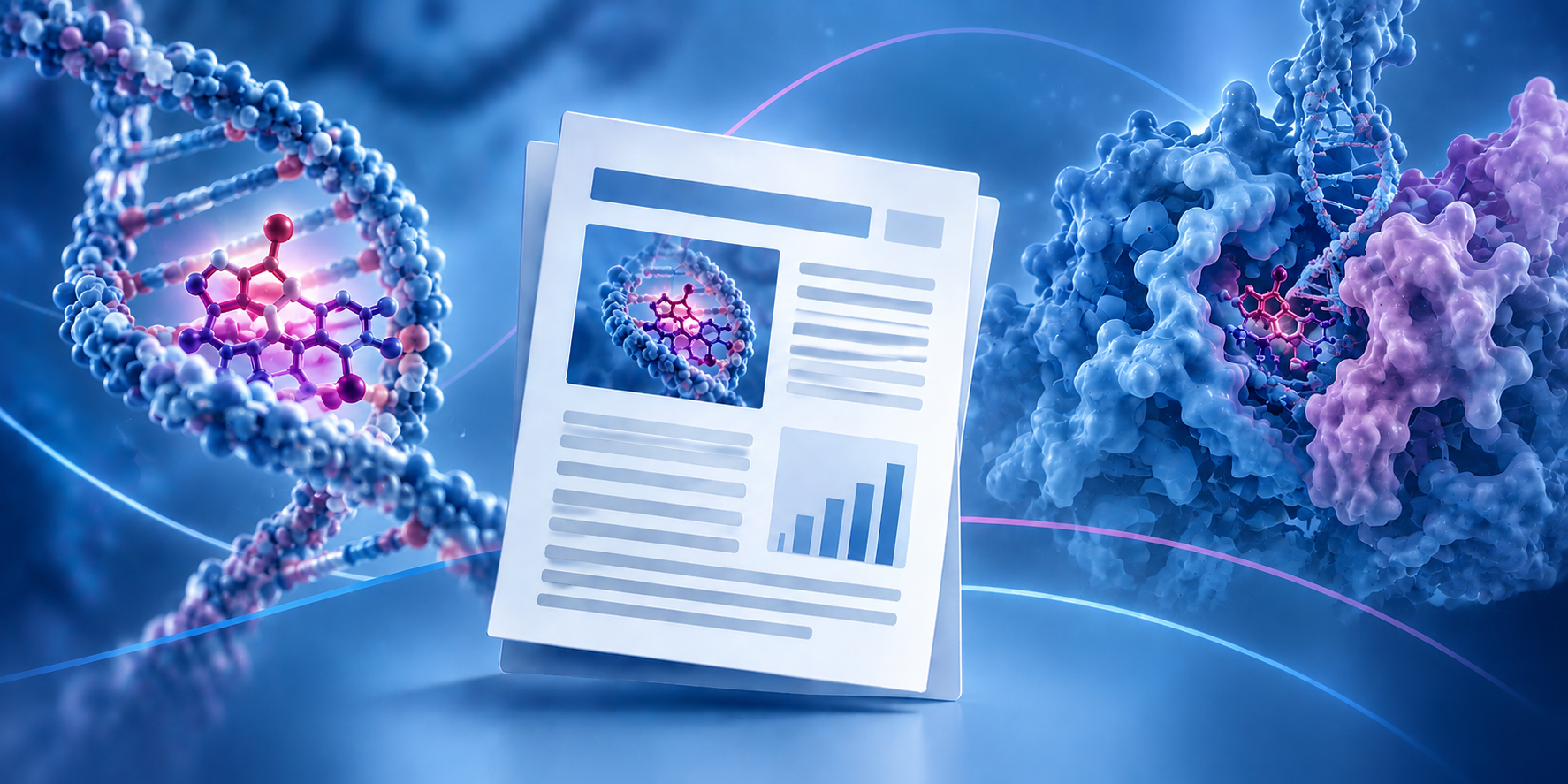
How strongly a drug binds to its biological target, and precisely which molecular interactions stabilise this binding, can be decisive for its therapeutic activity and unwanted side effects. Computational modelling increasingly allows researchers to investigate these mechanisms at an atomistic level, complementing experimental approaches.
In a new study, researchers Georgios Mikaelian, Haralambos Sarimveis, Doros N. Theodorou and Grigorios Megariotis from the PINK partner National Technical University of Athens (NTUA) investigated the interactions of two anthracycline anticancer drugs, doxorubicin and berubicin, with DNA and human topoisomerase II (TOPII). Their work combines all-atom molecular dynamics simulations with rigorous thermodynamic calculations to understand how these drugs stabilise DNA–TOPII cleavage complexes
“MD is a powerful computational method for tracking the time evolution of chemical and biomolecular systems; it may be envisioned as a computational microscope.”
Anthracyclines exert part of their anticancer activity by intercalating between DNA base pairs and stabilising complexes formed between DNA and topoisomerase II. This prevents the normal religation of cleaved DNA. Importantly, humans have two major TOPII isoforms: TOPIIα, which is highly expressed in proliferating cells including cancer cells, and TOPIIβ, which is expressed more widely.
The researchers simulated complexes containing both isoforms and analysed their molecular structures, contact networks, hydrogen bonds and other interactions. They then applied the computationally demanding double-decoupling method (DDM) to calculate standard binding Gibbs energies for selected complexes. This goes beyond simply identifying whether two molecules interact: it provides a quantitative thermodynamic description of how favourable their association is.
“DDM is considered one of the most detailed methods to calculate absolute binding free energies for complex biomolecular systems.”
The simulations reveal an interesting distinction between the two anthracyclines. Both drugs interact with DNA and TOPII, but berubicin forms more extensive contacts and shows particularly favourable binding to the DNA–TOPIIα complex. The calculated standard binding Gibbs energy for berubicin–DNA–TOPIIα is −117.1 ± 1.9 kJ/mol, compared with −97.9 ± 2.1 kJ/mol for berubicin–DNA–TOPIIβ and −79.3 ± 1.2 kJ/mol for doxorubicin–DNA–TOPIIα. The molecular simulations help explain this difference. Berubicin contains an additional benzyl group in its sugar moiety, making it more hydrophobic than doxorubicin. This modification strengthens interactions with both the DNA minor groove and TOPII residues, particularly within the more hydrophobic TOPIIα binding environment.
“The chemical modification of the sugar moiety in berubicin positively affects the interactions with both the minor groove of DNA and the residues of TOPII, especially TOPIIα.”
The results therefore illustrate how comparatively small changes in molecular structure can alter the interaction network and thermodynamic stability of a biologically important complex. This molecular-level understanding could ultimately support the rational design of new anthracycline derivatives. The study demonstrates a central principle behind computational approaches pursued within PINK: complex interactions between chemical structure, molecular properties and biological behavior can increasingly be explored in silico. Here, atomistic molecular dynamics and thermodynamic modelling connect a specific structural modification of a molecule with changes in intermolecular interactions and binding behavior. Such mechanistic computational approaches can contribute to earlier and more informed assessment of candidate chemicals and materials, complementing experimental evidence and supporting design decisions.
At the same time, the authors are careful about the limits of the present analysis. Their conclusions concern primarily structure and thermodynamics. A complete comparison between the two anthracyclines would additionally require investigation of their binding and unbinding kinetics, identified by the authors as a subject for subsequent work.
The research was supported by the EU Horizon Europe PINK project (Grant Agreement No. 101137809) and if you are interested in reading the full publication follow this link.