This is a particularly interesting paper for PINK because the connection is not merely thematic: PINK is one of the projects funding the core work on questionnaire development and modelling, alongside INSIGHT and NanoSolveIT. Scientifically, the paper combines expert knowledge, Bayesian modelling, experimental evidence, transcriptomics and machine learning. Several strands that fit very naturally into PINK’s computational SSbD context.
The development of new engineered nanomaterials (ENMs) is progressing faster than their potential health and environmental effects can be comprehensively assessed. At the same time, the transition towards New Approach Methodologies (NAMs) requires reliable data to develop computational alternatives to resource-intensive animal testing. A fundamental obstacle is therefore the lack of sufficiently comprehensive experimental safety data for many nanomaterials.
In their 2025 article “Wisdom of Crowds for Supporting the Safety Evaluation of Nanomaterials”, published in Environmental Science & Technology, Laura Aliisa Saarimäki and an international multidisciplinary team led by Dario Greco (researchers from our consortium partners UH, UoB, NovaMechanics, LIST, and EMPA among them) investigate an unconventional way of addressing this gap: systematically combining expert knowledge with experimental data and computational modelling.
“We hypothesized that complementary knowledge provided by experts could compensate for the lack of experimental nanosafety data for various classes of ENMs.”
The approach builds on the concept of the “wisdom of crowds” (WoC): under appropriate conditions, aggregated knowledge from a diverse group can provide more robust information than individual assessments. In the study, 21 participating experts evaluated 134 engineered nanomaterials across 18 toxicological endpoints, including cytotoxicity, genotoxicity, lung fibrosis and environmental hazards. Rather than simply taking a majority vote, the researchers used a Bayesian hierarchical model to derive probabilistic concern scores. The method accounts for differences in expert agreement as well as how difficult it is to reach consensus for individual toxicological endpoints. The resulting scores reveal groups of materials associated with lower, intermediate and higher levels of concern, as illustrated by the heat map and material classification in Figure 1 of the paper.
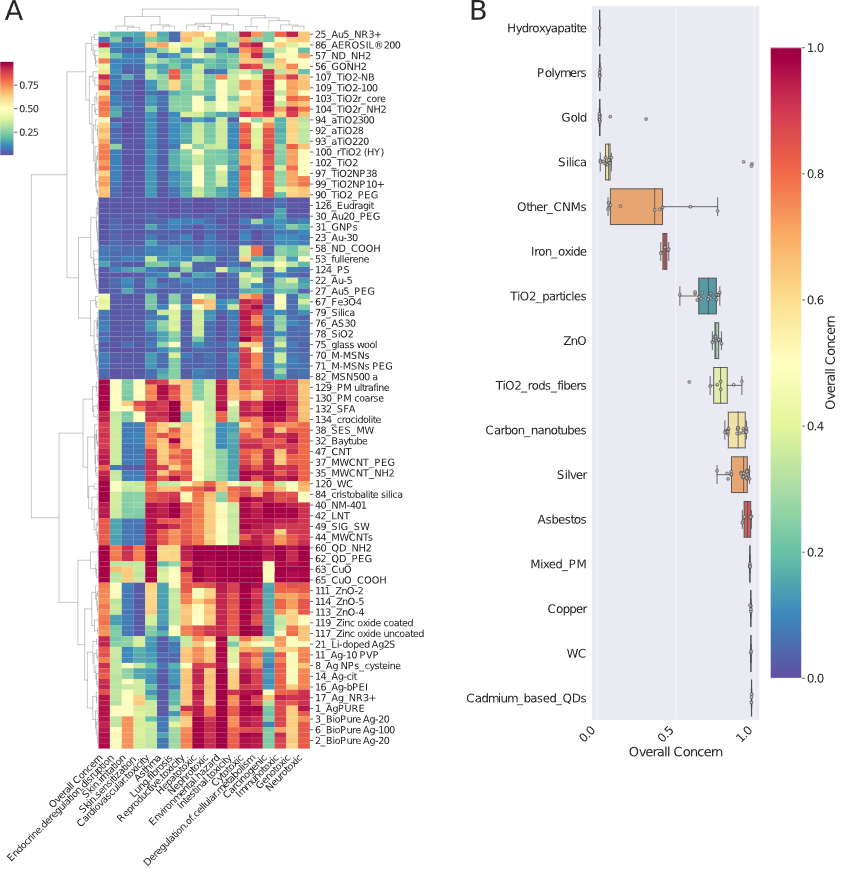
Figure 1 (taken from the publication): (A) Probabilistic concern scores for the studied ENMs and end points. Red indicates high levels of concern, while blue indicates low levels of concern. The ENMs are grouped based on the concern scores across the end points. The overall concern shows three distinct clusters by color (leftmost column). (B) Overall concern shown by the ENM category. ENMs were grouped by the core material and type.
Importantly, the expert-derived predictions were compared with available experimental cell-viability data. Higher predicted cytotoxicity concern generally corresponded with lower—or more variable—cell viability. The authors nevertheless emphasise that this represents supporting evidence rather than absolute validation, since comprehensive experimental datasets remain unavailable for many nanomaterials and endpoints.
“The complementary expertise of the multidisciplinary panel of experts can converge into robust consensus that aligns with experimental evidence.”
The study then goes one step further. Expert-derived concern scores were integrated with physicochemical descriptors and transcriptomic data to train machine-learning classifiers. This allowed the researchers not only to predict potential hazards but also to investigate possible biological mechanisms. Genes related to metal-ion homeostasis, inflammation, oxidative stress and DNA repair emerged as relevant predictors across several toxicity endpoints.
The study illustrates a challenge central to PINK and computational SSbD: how can safety-relevant decisions be supported when experimental information is heterogeneous or incomplete?
The proposed framework demonstrates that expert knowledge can itself become a structured data layer and be combined with physicochemical information, toxicogenomics and machine learning. Particularly relevant for SSbD is the possibility of using such models to prioritise materials for further testing, identify knowledge gaps and provide mechanistic information that may guide the development of safer materials.
At the same time, the study highlights the importance of uncertainty. Where experts strongly disagree, the framework does not simply hide this disagreement: high uncertainty can reveal areas where the available knowledge is insufficient and where additional experimental evidence should be prioritised. This makes the approach interesting not only for prediction, but also for directing future nanosafety research.
The study does not propose expert opinion as a replacement for experimental toxicology. Rather, it demonstrates how collective expertise can complement limited datasets and become part of an integrated computational safety-assessment strategy.
“This study showcases the value of integrating expert knowledge and computational modeling to support more efficient, mechanism-informed, and scalable safety assessment of nanomaterials…”
This combination of human expertise, experimental evidence and computational modelling provides a promising route towards more scalable NAMs and earlier integration of safety considerations into advanced-material development.
The core work on questionnaire development and modelling received financial support from the PINK project (Grant Agreement No. 101137809) together with other European research projects. Read the full publication.