From 1 to 3 June 2026, representatives of the PINK project participated in the DPP4EU Conference in Brussels, bringing together researchers, industry representatives, policymakers, and digital innovators working on the implementation of Digital Product Passports (DPPs). The conference focused on the role of DPPs in supporting the European Green Deal by enabling transparent, interoperable, and trustworthy product information throughout the entire product life cycle. Discussions covered technical standards, semantic interoperability, governance, and practical applications that will help establish DPPs as a cornerstone of Europe’s circular economy.
PINK contributed to the conference with two presentations highlighting complementary aspects of the project’s work.
Jesper Friis (SINTEF) presented “A Semantic Framework for Materials Knowledge in Digital Product Passports”. His presentation demonstrated how semantic technologies and ontologies can transform heterogeneous materials data into interoperable, machine-readable knowledge that can be integrated into Digital Product Passports. By providing a common semantic foundation for materials, manufacturing processes, characterization data, and modelling results, the framework supports FAIR data principles while enabling efficient reuse of information across the product lifecycle. This work addresses one of the key technical challenges for future DPPs: ensuring that complex materials information can be consistently interpreted and exchanged across organisations and digital systems.
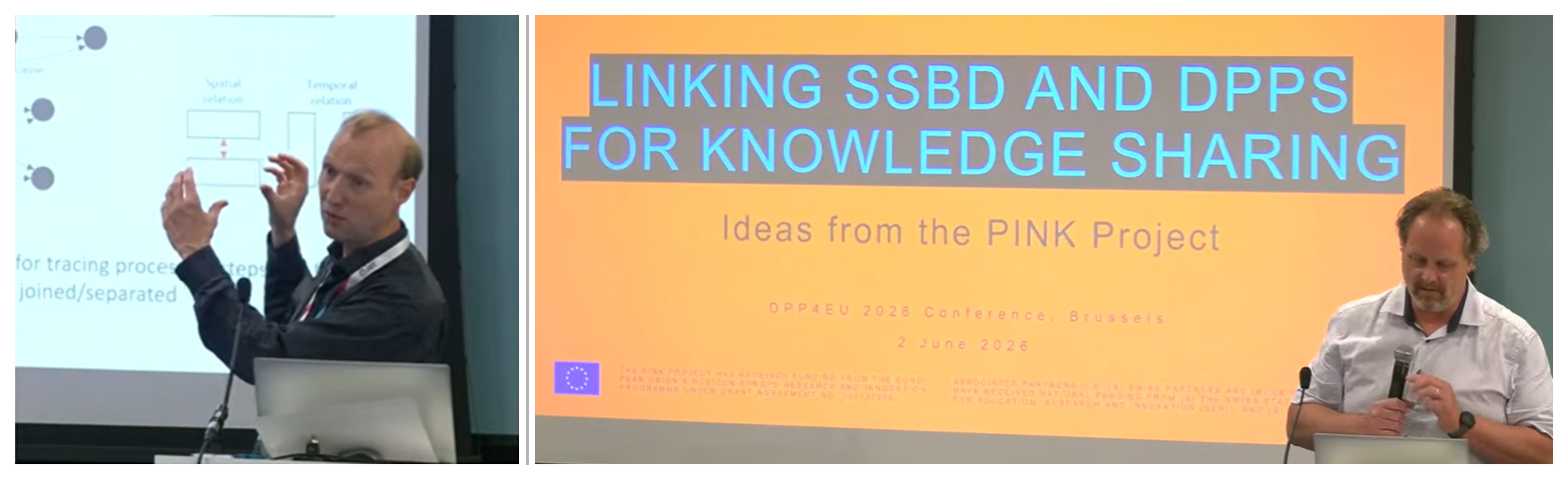
Later in the programme, Thomas Exner (Seven Past Nine) presented “Leveraging Digital Product Passports for Responsible Research and Innovation: Integrating SSbD Data Flows”. The presentation explored how Digital Product Passports can evolve beyond regulatory compliance to support Safe-and-Sustainable-by-Design (SSbD) approaches throughout material and product development. Drawing on the semantic, technical, and quality assurance frameworks developed within PINK, the presentation illustrated how trusted data flows between Digital Material Passports and Digital Product Passports can facilitate the exchange of sustainability and safety information across value chains. This enables better-informed design decisions while supporting recycling, remanufacturing, and other circular economy processes.
Thomas Exner (Seven Past Nine): “We want to guide SMEs to put this information about functionality, but then also sustainability and safety into their early research and innovation.”
Together, the two presentations demonstrated how PINK contributes to the next generation of Digital Product Passports by combining robust semantic data infrastructures with mechanisms for trustworthy sustainability information exchange. These complementary developments help establish DPPs not only as regulatory tools, but also as enablers of data-driven innovation, circularity, and sustainable materials development.