SINTEF Ocean conducts research and innovation related to the ocean space for national and international industries. Its work supports sustainable use of the ocean across core ocean-based sectors, including transport, food and energy production, while drawing on strong competence in marine technology, biomarine research, marine environmental technology and digital research methods.
Within SINTEF Ocean, the Climate and Environment department contributes expertise that is relevant to PINK’s ambition to make complex scientific information more reusable, interoperable and useful across disciplines. The department is associated with research on the marine environment, environmental risk, environmental chemistry, sustainability and environmental technology. This includes work on the protection of marine ecosystems, sustainable industrial development in the ocean space, and the fate and effects of pollutants.
SINTEF Ocean also brings experience from data-intensive and interoperability-oriented European research projects. One relevant example is VIPCOAT (Virtual Open Innovation Platform for Active Protective Coatings Guided by Modelling and Optimisation). VIPCOAT developed an ontology-based open innovation platform to support the development of active protective coatings, combining experimental data, industry-relevant data, modelling, simulation workflows and interoperable applications. This experience is directly relevant to PINK’s focus on FAIR data, semantic interoperability and the practical reuse of research knowledge across domains.
The role of SINTEF Ocean in the PINK Project
Within the PINK Project, SINTEF Ocean contributes to the development of assisted FAIR data documentation workflows that support the PINK infrastructure and its wider interoperability framework. This work focuses on helping project partners convert knowledge that is currently stored in reports, templates, spreadsheets, experimental notes, and other documentation into structured, reusable and traceable FAIR assets.
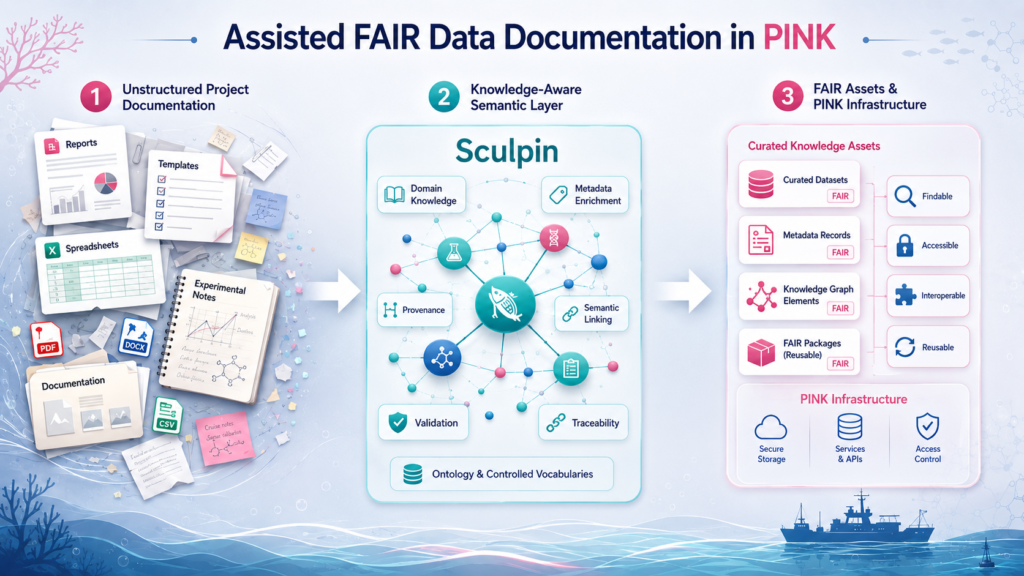
A key element of this contribution is the use of Sculpin, part of the SemanticMatter technology ecosystem. Sculpin supports knowledge-aware workflows where information from documents can be organised, linked to relevant domain concepts, enriched with metadata and connected to provenance. In PINK, this provides a practical way to move from unstructured project documentation towards curated knowledge assets that can be searched, reviewed, validated, and reused across the project.