Luxembourg Institute of Science and Technology
Luxembourg Institute of Science and Technology (LIST) is active in the fields of information technology, materials, space resources and the environment. LIST develops competitive and market-oriented product/service prototypes for public and private stakeholders. It works across the entire innovation chain: fundamental/applied research, incubation, technology transfer. By transforming scientific knowledge into technologies, smart data and tools, LIST empowers citizens in their choices, public authorities in their decisions and businesses in their strategies. This passion for innovation extends to the field of environmental health, where LIST’s research plays a crucial role in advancing sustainable scientific practices.
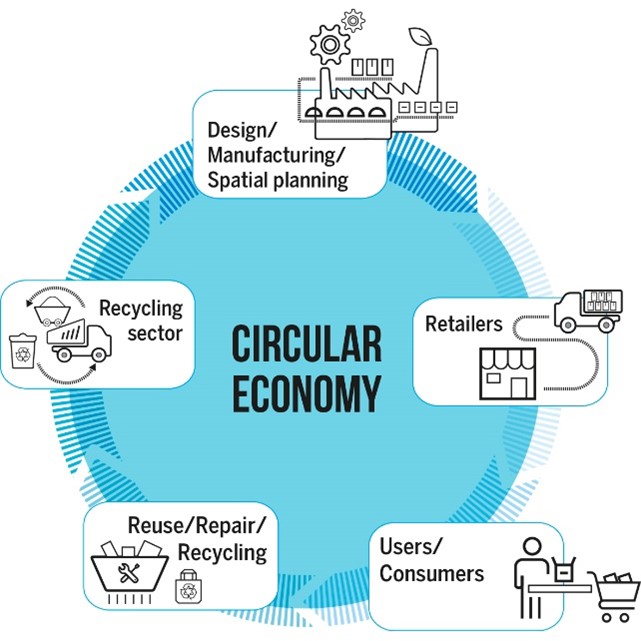
To evaluate systemic impacts and long-term performance, transition pathways require tools that evaluate production and consumption systems against planetary boundaries, measure impacts across full life cycles and value chains, assess social and ecological returns alongside financial ones and consider long-term implications across generations. The Environmental Sustainability Assessment and Circularity (SUSTAIN) research Unit supports sustainability transitions by embracing regenerative design principles that restore rather than deplete natural resources, establishing circular material flows that eliminate waste and prioritizing durability, repairability and recyclability.
Circular economy principles are at the core of the SUSTAIN research unit at LIST
SUSTAIN can offer a comprehensive assessment that encompasses lifecycle‑based evaluations (underpinned by the life cycle assessment methodology – LCA) and includes human health impact assessment with in vitro and in silico toxicology. LIST’s activities in evaluating the absolute sustainability (i.e. considering planetary boundaries) of production and consumption systems, measuring impacts across full life cycles and value chains, and assessing social and ecological returns alongside financial ones (consider long-term implications across generations) are carried out by the Industrial Ecology (IE) and the Life Cycle Sustainability Assessment (LCSA) groups. The two groups, led respectively by Dr. Antonino Marvuglia and Dr. Tomás Navarrete Gutiérrez, integrate very interdisciplinary expertise, demonstrated through the development of several hybrid LCA models, where LCA is coupled with cutting-edge computational models integrating various approaches and algorithms. LIST’s activities in developing in vitro assays as replacement of animal experiments, nano-toxicology and risk assessment are undertaken by the Environmental Health (EH) research group. The EH team, led by Dr. Tommaso Serchi, has extensive experience in the development of complex in vitro models for human safety. In addition, the EH group has large experience in human and environmental risk assessment, in the development of alternative testing strategies for nano-materials and chemicals, in eco-toxicology and in the development of New Approach Methodologies (NAMs), including3D in vitro models, particularly for the lung (alveolar region) and the small intestine.
The role of LIST in the PINK Project
Within the PINK Project, LIST main contributions unfold in two main roles: (1) is responsible for Task 2.3 on Exploratory and Prospective LCA, where they apply advanced machine learning (ML) and artificial intelligence (AI) methods, including the most recent architectures based on agentic AI, to allow life cycle inventory building and ex-ante impact assessment of new chemicals, that will be ultimately used to facilitate the sustainability step of the Safe and Sustainable by Design (SSbD) framework for advanced materials and chemicals (AdMas&Chems); (2) provides support and guidance in validating the New Approach Methodologies (NAMs) tested in the project.
In its capacity within the PINK Project, LIST contributes to the construction of the LIST self-training infrastructure and PINKISH, the platform providing decision support based on advanced data visualisation and Generative AI technologies that will be released at the end of the project.