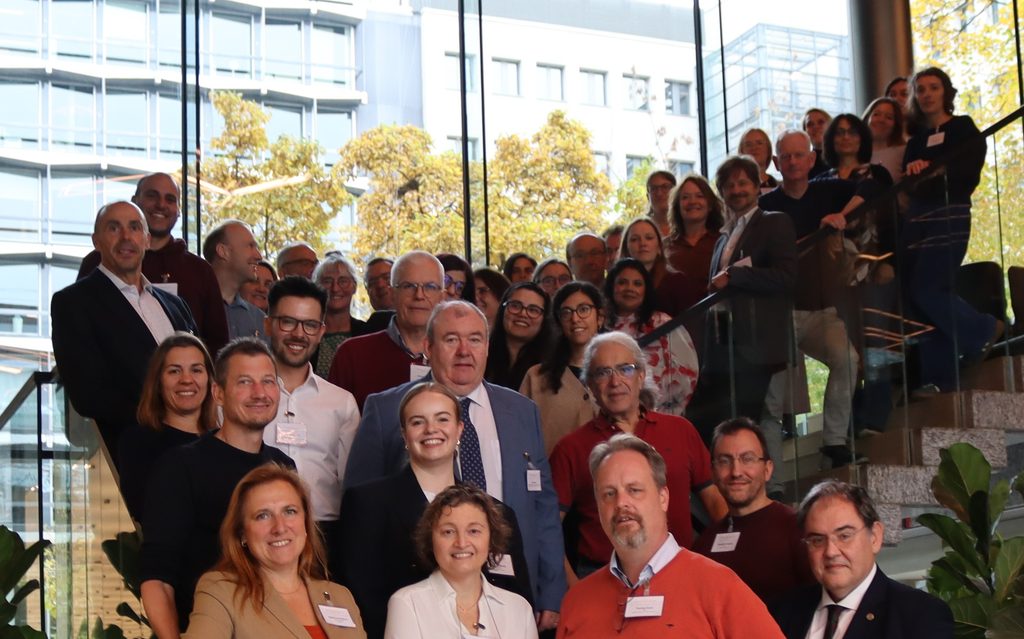
More than 40 representatives of European Safe-and-Sustainable-by-Design (SSbD) research and innovation projects, stakeholder initiatives, industry associations and the European Commission gathered in Brussels for the SSbD Legacy Workshop. A further 10–20 participants joined and contributed online, reflecting the broad interest in ensuring that the results of European SSbD research remain accessible and useful beyond the lifetime of individual projects.
The workshop was jointly organised by the European research projects PINK, CHIASMA, BIO-SUSHY, PLANETS, INTEGRANO and SUNRISE, with the endorsement of NSC. It was held in close connection with the European Commission’s Feedback-to-Policy Stakeholders’ Workshop on 4–5 November, allowing many participants to contribute to both events.
Building a lasting legacy for European SSbD research
The main objective of the Legacy Workshop was to explore how the results developed by European SSbD projects launched under the RES-21 to RES-24 and and a few other calls could be consolidated and further exploited. Rather than considering project results in isolation, the workshop sought to identify complementarities and opportunities for collaboration, as well as potential organisations or initiatives capable of maintaining and further developing these results after the projects have ended.
In preparation for the workshop, more than 21 invited projects had been asked to document selected results using a common Legacy Card format. By the Friday preceding the event, 45 Legacy Cards had already been submitted, with contributions from all participating projects. The collection remained an ongoing process, with further cards arriving even on the day of the workshop. The submitted cards provided the basis for a preliminary mapping of project outcomes and their potential connections, giving participants a structured starting point for their discussions.
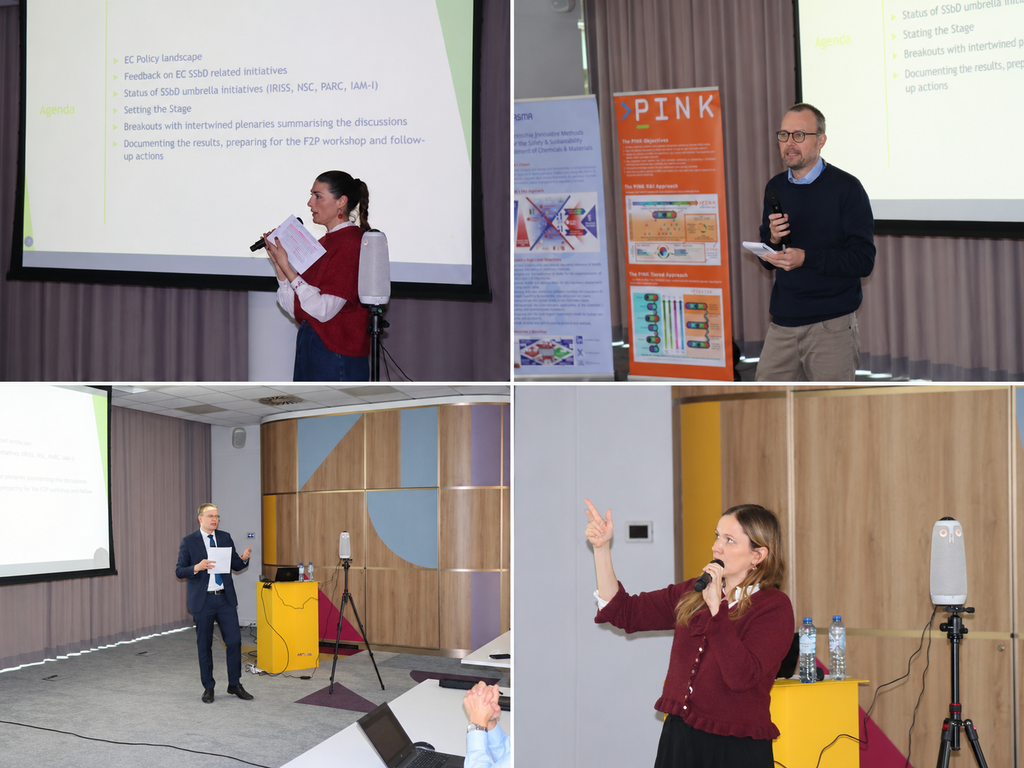
From top left to bottom right: Florina-Andreea Pantazi (DG Grow), Paul Speight (DG ENV), Carsten Schierenbeck and Sophie Lemahieu (both DG RTD)
Policy perspectives and collaborative discussions
Following a welcome by Thomas Exner, the workshop opened with contributions from representatives of three European Commission Directorates-General: Sophie Lemahieu and Carsten Schierenbeck (DG RTD), Florina-Andreea Pantazi (DG GROW) and Paul Speight (DG ENV). Their interventions provided perspectives on the European policy context, the role of research and innovation, and the importance of translating SSbD project results into lasting benefits.
Representatives of stakeholder initiatives, including Eva Schillinger (IAM-I, PINK partner), Emma Stroemberg (IRISS), Andreas Falk (NSC) and Denis Sarigianis (PARC), also introduced their activities and approaches to consolidating and making SSbD knowledge accessible. The SSbD Nexus was presented by Lya Hernandez-Soeteman.
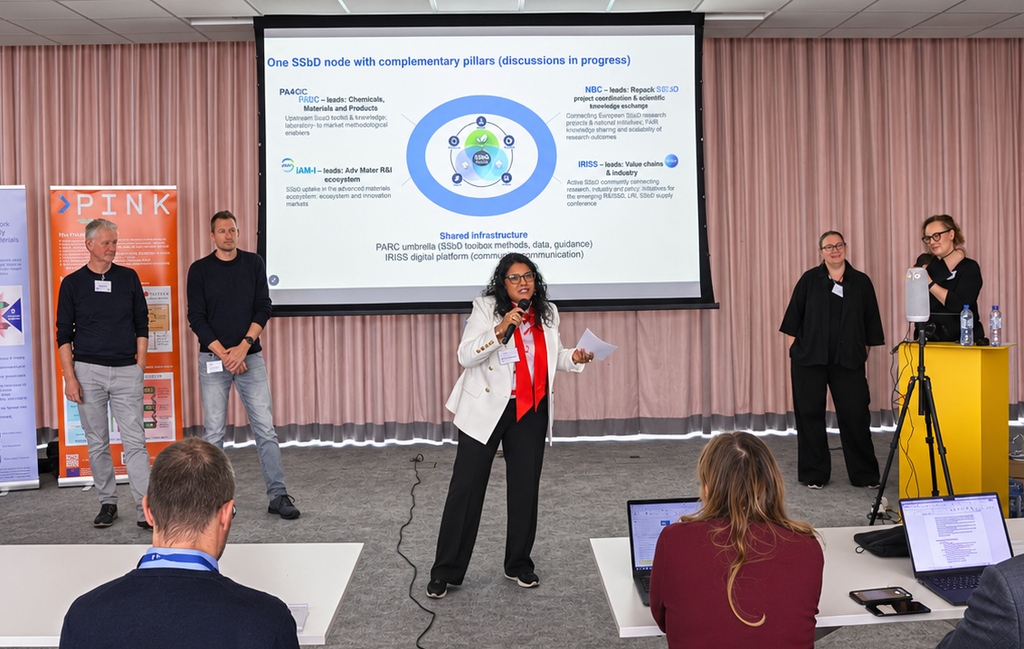
Lya Hernandez-Soeteman together with Jaco Westra (representing PARC), Andreas Falk (NSC), Emma Stromberg (IRISS), and Eva Schillinger (IAM-I) presenting main contributing organisations of the European SSbD ecosystem.
The workshop then continued with interactive breakout sessions in which participants examined the individual project results and their potential for further use. During the first round, participants reviewed and validated the previously submitted Legacy Cards, identified overlaps and complementarities between project outcomes, and explored opportunities for further collaboration. The second round focused on connecting these results with existing stakeholder initiatives and potential Legacy Keepers – organisations or structures that could take responsibility for maintaining or further developing selected outcomes. Emerging initiatives and concepts, including Materials Commons, IAM4EU+ and SSbD Hubs, were also discussed as possible future contributors to a sustainable European SSbD ecosystem.
Findings from the workshop
After two intensive half-days, one important observation was that collaboration between the SSbD projects is already well established in several areas. Existing cooperation provides a useful basis for further joint activities. At the same time, the discussions revealed additional opportunities for collaboration, particularly in the following areas:
- Methods and tools for implementing SSbD approaches;
- Data and research infrastructures supporting their application;
- Training, knowledge management and capacity building;
- Demonstrators, industrial applications and scale-up.
A key conclusion was that bringing together related project outcomes can create additional value for potential users of the SSbD framework. Clustering complementary results could also help establish the critical mass needed for their further development and wider uptake.
The feedback from participants was very positive. There was broad agreement that discussing project legacies collectively, rather than pursuing separate approaches for each project, offers considerable benefits. The workshop was regarded as a useful starting point for continuing this process.
Agreed next steps
The workshop was conceived as the beginning of a longer process. Building on the discussions and feedback received, several follow-up activities were agreed. In the coming weeks, contributors will have the opportunity to revise their Legacy Cards to reflect insights gained during the workshop and to submit additional results/cards where appropriate.
These inputs will be used to revise and finalise the consolidated SSbD Legacy Map, which will illustrate connections between project outcomes, potential collaborations and possible Legacy Keepers. In parallel, a Legacy Roadmap will be developed to outline the next steps towards consolidating and sustaining the identified results. Participants also agreed to document the underlying methodology and initial findings in a Policy Brief, making the approach and its relevance available to a wider audience.
Links to European policy development
The Legacy Workshop was closely linked to the Feedback-to-Policy Stakeholders’ Workshop, jointly organised by the European Health and Digital Executive Agency (HaDEA) and DG RTD on 4–5 November at the Conference Centre A. Borschette in Brussels. This event brought together more than 130 participants representing 95 EU-funded project consortia, European Commission services and HaDEA. Covering several Horizon Europe Cluster 4 industry areas, including advanced materials, manufacturing, SSbD and metrology, the workshop examined lessons learned from ongoing research and innovation projects and their relevance for future European policy and funding priorities, particularly FP10 and the European Competitiveness Fund.
In a dedicated report-back session, Thomas Exner presented the approach and initial outcomes of the SSbD Legacy Workshop to the participants of the Commission’s event. The presentation was received with considerable interest and provided an opportunity to bring the findings of the SSbD community into the wider European policy discussion.
A summary report of the Feedback-to-Policy Workshop is expected to be published by HaDEA in early 2027.
Further information is available in the official HaDEA news article.
Outlook
In addition to the specific results and follow-up activities, the Legacy Workshop strengthened communication between the participating projects and facilitated new contacts. The direct exchange with policymakers from three European Commission Directorates-General was particularly valuable. For PINK, which is entering a phase of increased external communication and dissemination of its results, the workshop provided an opportunity to contribute to these joint activities and explore possibilities for the continued use of its research outcomes. A potential next milestone could be another Legacy Event in about one years time.