Founded in 1640, University of Helsinki (UH) is an international research community of over 40,000 students and staff, with top research areas in future technologies, sustainable planet, precision health, and learning and evolving societies. Belonging to this community there are some members of the Finnish Hub for Development and Validation of Integrated Approaches (FHAIVE), a Finnish research center that operates across the UH and Tampere University (TAU). FHAIVE is an international team (about 35 researchers from ~10 countries) led by Professor Dario Greco focused on building data-driven, mechanistic methods to predict the safety of chemicals for humans and the environment, while also contributing to biomedical applications such as improving drug efficacy and safety profiling. It brings together expertise in toxicology, bioinformatics and computational modelling to modernize chemical safety assessment (CSA). Its core mission is to develop and validate Integrated Approaches to Testing and Assessment (IATA), approaches that combine multiple sources of evidence to support safety decisions, by integrating advanced in vitro models, toxicogenomics, and AI-enabled data modelling. FHAIVE also plays a national role in advancing animal-free testing: it acts as Finland’s national reference laboratory for validating alternative methods and promotes the 3Rs (Replacement, Reduction and Refinement) in research and testing. To ensure that new methods are not only innovative but also trustworthy and transferable, FHAIVE is an official GLP laboratory certified by Finnish Medicines Agency (FIMEA).
Professor Dario Greco explains that his research applies system-based approaches to study how chemicals and drugs affect biological systems as complex, interconnected and dynamic networks across multiple level of organization, enabling more accurate prediction of toxicological risks and therapeutic effects while supporting faster, safer, and more cost-effective drug and chemical development (see also here).
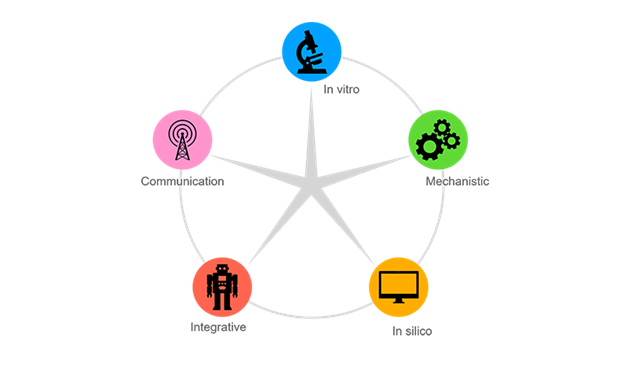
The group’s work is organized across five connected areas: mechanistic, in vitro, in silico, integrative, and communication so that experimental development, mechanistic interpretation, computational prediction and real-world uptake progress together.
FHAIVE’s areas of interest.
The role of UH in the PINK Project
Within UH, the work contributing to this project is carried out by a multidisciplinary team of experts including Professor Dario Greco, Lecturer Angela Serra, Docent Antonio Federico, PhD students Cristina Accardi, Giorgia Ciancaleoni, and Zeyad Al-Abdulraheem.
UH brings its expertise in toxicogenomics, AOP-based safety assessment, and knowledge graph approaches, leading tasks on risk modelling and chemical impact assessment while supporting FAIR (Findable, Accessible, Interoperable, and Reusable) data integration and case studies across the PINK project.
UH is leading two main tasks including Task 2.4 “Risk assessment through AOP modelling from toxicogenomics data and biokinetics simulations” and Task 4.3.2 “Integrated Knowledge Graph for Chemical Impact Assessment”.
Under task 2.4 UH developing tools that systematically connect molecular level evidence, including bioassay activity and omics data, to the AOP framework, enabling more mechanistically grounded risk evaluation. Furthermore, within Task 4.3.2, UH leads the development of a Chemical Impact Assessment Knowledge Graph (KG). The KG links chemical exposures to molecular level evidence and mechanistic events, enabling predictive analyses to identify previously unknown connections between chemical exposures and human diseases. This approach is demonstrated through a dedicated case study on phthalates, supporting mechanistically informed risk assessment for human health and the environment.