Bringing advanced computational models from specialists to everyday users
Advanced computational models for chemicals and materials are increasingly available – but developing a powerful model is only part of the challenge. For these methods to influence everyday research and material design, they also need to be accessible to scientists who are not specialists in programming or computational modelling.
This is the gap addressed by Dimitra-Danai Varsou and colleagues from project partner Nova Mechanics through the Enalos Cloud Platform. Rather than introducing a single new predictive model, the platform provides a user-friendly gateway to a broad collection of computational tools for cheminformatics, nanoinformatics and advanced materials informatics. Its aim is to make sophisticated modelling approaches easier to access, understand and apply – while retaining information on their scientific basis and the reliability of their predictions.
“To bridge this gap, all models need to be made readily available through user-friendly platforms and fully documented in terms of their modelling approaches and the basis for prediction.”
One platform – multiple computational approaches
At the time described in the publication, Enalos Cloud offered 50 computational tools covering areas including cheminformatics, nanoinformatics, materials engineering, image analysis, exposure and biokinetics. The underlying workflows combine established computational environments and software – including KNIME, WEKA, ImageJ, R, Python, LAMMPS and DeepChem – with dedicated tools that connect these components into usable workflows. Importantly, the platform does more than return a prediction. Model outputs can be accompanied by information on the applicability domain, helping users judge whether a model is being applied within the chemical or materials space for which its prediction can be considered reliable. Documentation, user guides and scientific publications describing model development and validation further support transparency and interpretation.
Supporting safety assessment before a material is made
This accessibility becomes particularly relevant for Safe and Sustainable by Design (SSbD). Tools available through the platform can, for example, digitally construct nanoparticles, predict physicochemical properties and assess potential adverse effects. The publication highlights SafeNanoScope for predicting effects on human liver cells and ecotoxicological read-across models addressing effects on Daphnia magna. Different computational tools can also be combined within an Integrated Approach to Testing and Assessment (IATA). This enables virtual materials to be screened on the basis of their structure and composition before they are synthesised.
“Large sets of theoretically constructed nanomaterials can be virtually screened to rapidly evaluate their desired properties […] and therefore it is possible to prioritize promising candidates for synthesis and further evaluation.”
This shifts computational assessment upstream in the innovation process: rather than assessing a material only after it has been produced, modelling can help identify promising candidates and potential concerns while design choices can still be changed.
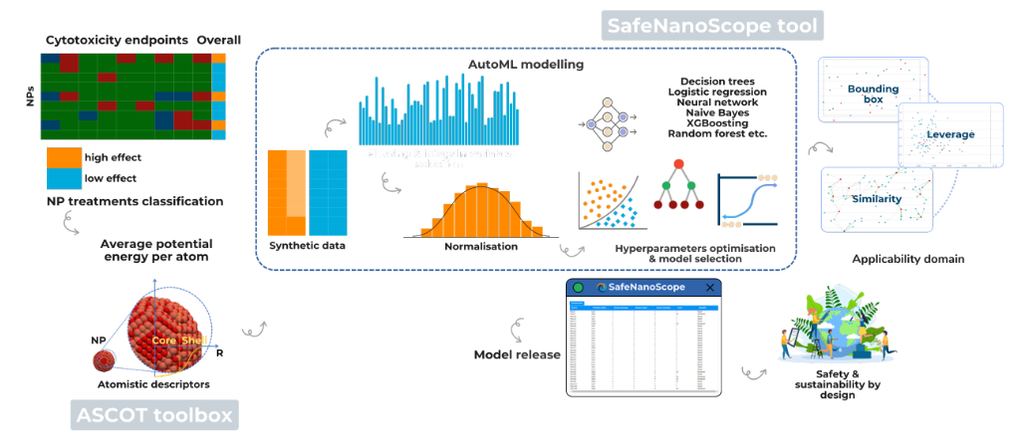
Fig. 1 (taken from the publication): The IATA concept applied in nanoinformatics through the ASCOT and the SafeNanoScope Enalos Cloud web services.
Why this matters for PINK
This approach is closely connected to the objectives of PINK. Making validated computational models accessible, transparent and usable is an important step towards translating digital methods into practical SSbD decision support.
The Enalos approach demonstrates several principles that are central to this transition: combining complementary computational methods, documenting their scientific basis, communicating model applicability and uncertainty, and allowing non-programming specialists to use sophisticated models through accessible digital interfaces.
For PINK, these capabilities contribute to a broader goal: connecting data, models and knowledge so that safety and sustainability considerations can inform material design as early as possible. The challenge for materials informatics is therefore not only to develop better predictive models. These models also need to become accessible, understandable and trustworthy to the scientists, material developers and other stakeholders expected to use them. By lowering the technical barriers to computational assessment, platforms such as Enalos Cloud can help turn in silico methods from specialist research tools into practical components of data-driven materials design.
The work was supported by several European research projects, including the Horizon Europe PINK project (GA No. 101137809). If you are interested in reading the full publication follow this link.