Scientists from PINK project partners Luxembourg Institute of Science and Technology (LIST), Paris Lodron University Salzburg (PLUS), BASF SE, School of Chemical Engineering at National Technical University of Athens (NTUA), Istituto di Scienza e Tecnologia dei Materiali Ceramici (CNR-ISSMC), AcumenIST SRL (AIST), Seven Past Nine (7P9), and the Technology and Society Laboratories at Swiss Federal Laboratories for Materials Science and Technology (Empa) were lead- and co-authoring in the following publication:
Larrea-Gallegos, G. M., Hofer, S., Hofstätter, N., Punz, B., Watzek, N., Lölsberg, W., Wiench, K., Wohlleben, W., Garmendia Aguirre, I., Nikolakopoulos, A., Sarimveis, H., Neagu, D., Madiec, P., Cassio, I., Seitz, C., Friedrichs, S., Exner, T. E., Hischier, R., Marvuglia, A., & Himly, M. (2025). Integrate & balance aspects for safe and sustainable innovation: Needs analysis on SSbD categories and product development stage requirements to cover the entire life cycle. Computational and Structural Biotechnology Journal, 29, 201–221. https://doi.org/10.1016/j.csbj.2025.07.030
The article presents a rigorous and systemically grounded analysis of how Safe and Sustainable-by-Design (SSbD) can be operationalized across the entire life cycle of chemicals and advanced materials (ChAMs). The authors explicitly align their conceptualization with the European Green Deal’s twin transition, noting that “an underlying adaptation of the research and innovation (R&I) process to the Safety- and-Sustainability-by-Design framework has been proposed” to support a digitally enabled, circular, and climate-neutral industrial landscape. Their analysis integrates regulatory science, industrial design logic, and computational sustainability assessment within a unified multi-criteria decision-making paradigm.
The authors ground SSbD within the Joint Research Centre (JRC) framework, describing it as “a holistic, precautionary, and highly formalized framework” that structures innovation through iterative stage-gate processes, each linking redesign loops with gate-based assessments (hazard, exposure, environmental sustainability, and socio-economic performance). This provides the foundation for the paper’s central thesis: SSbD can only be effectively implemented when safety, functionality, and sustainability parameters are co-optimized from the earliest research stages, supported by “digital modeling and decision support systems” that compensate for the low-data environment characteristic of early R&I phases.
A major conceptual contribution lies in the authors’ systematic mapping of SSbD categories to product development stages, clarifying that safety and sustainability must not be treated as terminal evaluations but as design constraints embedded in ideation, synthesis, prototyping, scale-up, and market introduction. This mapping is operationalized through the Horizon Europe PINK project, which serves not only as an illustrative case but as an empirical backbone demonstrating feasibility. PINK exemplifies the integration of mechanistic safety assessment (NAMs, AOPs, IATAs), life-cycle modeling, and iterative gate reviews, allowing industrial actors to “fail early and refine assessments as the innovation process evolves”.
Under the “S as in Safety” dimension, Larrea-Gallegos et al. critically examine the interface between emerging New Approach Methodologies (NAMs) and regulatory acceptance pathways. They emphasize that NAMs – including in silico (QSAR, machine learning), in chemico, and in vitro high-content assays – enable “early hazard screening through analytics of synthesized structures and impurities”. However, the authors highlight persistent regulatory barriers: “Most often, the data generated by NAMs alone are not currently regarded as adequate… for hazard identification and characterization”. To reconcile methodological innovation with regulatory viability, they advocate hybrid evidence strategies, integrating NAMs with mechanistic AOP-anchored reasoning, targeted in vivo data, and structured uncertainty characterization.
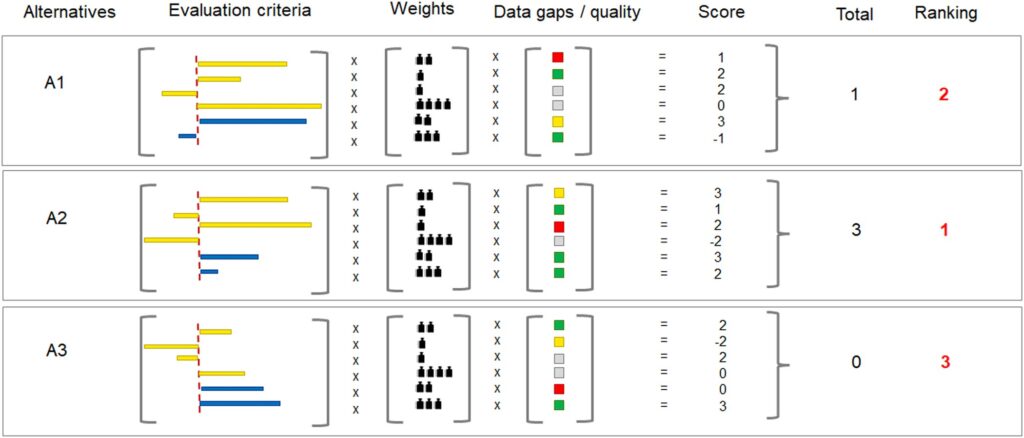
The Assessment of Alternatives (AoA) is examined as a core procedural instrument for SSbD decision-making. The authors describe AoA as a “structured methodology involving hazard, technical feasibility, economic feasibility, exposure characterization, life-cycle impacts, and decision-making”. They identify the scoping phase as the locus for identifying functional requirements and potential redesign leverage points, warning against the “drop-in replacement trap”, where structurally similar but still hazardous substitutes (e.g., PFAS analogues) are introduced without systemic functional redesign. Instead, they propose a hierarchical intervention logic spanning molecular, material, product, and system-level redesign options.
From a sustainability standpoint, the authors introduce a forward-looking conceptualization of prospective and anticipatory Life-Cycle Assessment (LCA). They argue that conventional, retrospective LCA is insufficient for early-stage SSbD, calling instead for digital approaches that “can overcome the absence of data at early innovation stages”. The authors strengthen this section by integrating AI and machine learning taxonomies, based on Liao et al. (2022), to delineate two complementary pathways: (i) data-driven prediction of environmental performance and (ii) model-based multi-objective optimization of design parameters. They argue that such digitalisation is indispensable to making SSbD “practicable and manageable within the resource constraints of innovation projects”.
The paper also incorporates use-maps and exposure scenario frameworks from the ECHA CSR/ES Roadmap, highlighting the crucial role of value-chain information in constructing realistic life-cycle exposure models (p. 210). This reinforces their broader argument that SSbD implementation requires interoperable databases, standardized ontologies, and federated data spaces, enabling “trusted and transparent data exchange” without compromising industrial competitiveness.
The article positions SSbD as a systems-level innovation paradigm rather than a compliance tool. It stresses that “SSbD will provide the most benefit when it is applied to include as many layers as possible, providing a holistic view on the material life cycle and value chain”. The authors envision SSbD as an iterative, multi-objective, AI-supported design logic that aligns European technological competitiveness with environmental and human-health protection.
Follow this link to read the full publication.
Parts of the research of this work (all authors) has been funded by the European Union`s R&I project PINK (grant agreement # 101137809).