Scientists from the PINK project partner Paris Lodron University Salzburg (PLUS), were lead- and co-authoring in the following publication:
Punz, B., Christ, C., Waldl, A., Li, S., Liu, Y., Johnson, L., Auer, V., Cardozo, O., Farias, P. M. A., Andrade, A. C. D. S., Stingl, A., Wang, G., Li, Y., & Himly, M. (2025). “Nano-scaled advanced materials for antimicrobial applications – mechanistic insight, functional performance measures, and potential towards sustainability and circularity.” Environmental Science: Nano, 12, 1710–1739. https://doi.org/10.1039/d4en00798k
This comprehensive tutorial review synthesises mechanistic, methodological, and sustainability-oriented insights into nano-scaled advanced materials for antimicrobial applications. The work responds to the global challenge of antimicrobial resistance (AMR), which causes “more than half a million deaths annually” and threatens the efficacy of conventional antibiotics. The authors emphasise that “research and innovation have focused on nano-scaled advanced materials to explore their potential to reinforce antimicrobial treatments”, positioning such materials as a promising frontier for infection prevention and control, particularly on surfaces and protective equipment.
The review’s scope is fivefold: (i) identification of engineered nanomaterial candidates and their defining physicochemical properties; (ii) mechanistic elucidation of antimicrobial action; (iii) presentation of methodological and analytical frameworks for evaluating efficacy; (iv) integration of sustainability and circularity principles in material design; and (v) exploration of emerging application domains spanning medical, agricultural, textile, and food industries. The authors categorise nano-scaled advanced materials into organic, inorganic, and hybrid nanomaterials, each offering distinct advantages and challenges. “Organic NPs, often derived from biopolymers like chitosan or synthetic polymers, offer biocompatibility and versatility,” particularly in wound healing and drug delivery. In contrast, “inorganic NPs, exemplified by materials like Ag, Cu, and ZnO, are known for their potent and broad-spectrum antimicrobial activity”. Hybrid materials aim to leverage both. Crucially, antimicrobial effectiveness depends on physicochemical attributes—including size, surface modification and charge, topography, and dissolution behavior. The review stresses that “smaller NPs typically have a higher surface area per unit mass,” enhancing microbe interaction, while “positively charged NPs exhibit enhanced cellular internalization capacity” due to electrostatic attraction to negatively charged microbial membranes. Topographical factors such as “shape, morphology, curvature, and roughness” determine adhesion and uptake, with nanorods and roughened surfaces enhancing microbicidal performance. The dissolution process, particularly ion release, is a key functional determinant for metal-based NPs. Following the Noyes–Whitney relation, “reducing particle size increases the total effective surface area whilst enhancing the dissolution rate”. Consequently, dissolution dictates both short-term potency and long-term material stability, defining the balance between efficacy and durability.
Three core mechanistic pathways are systematically described and visualised:

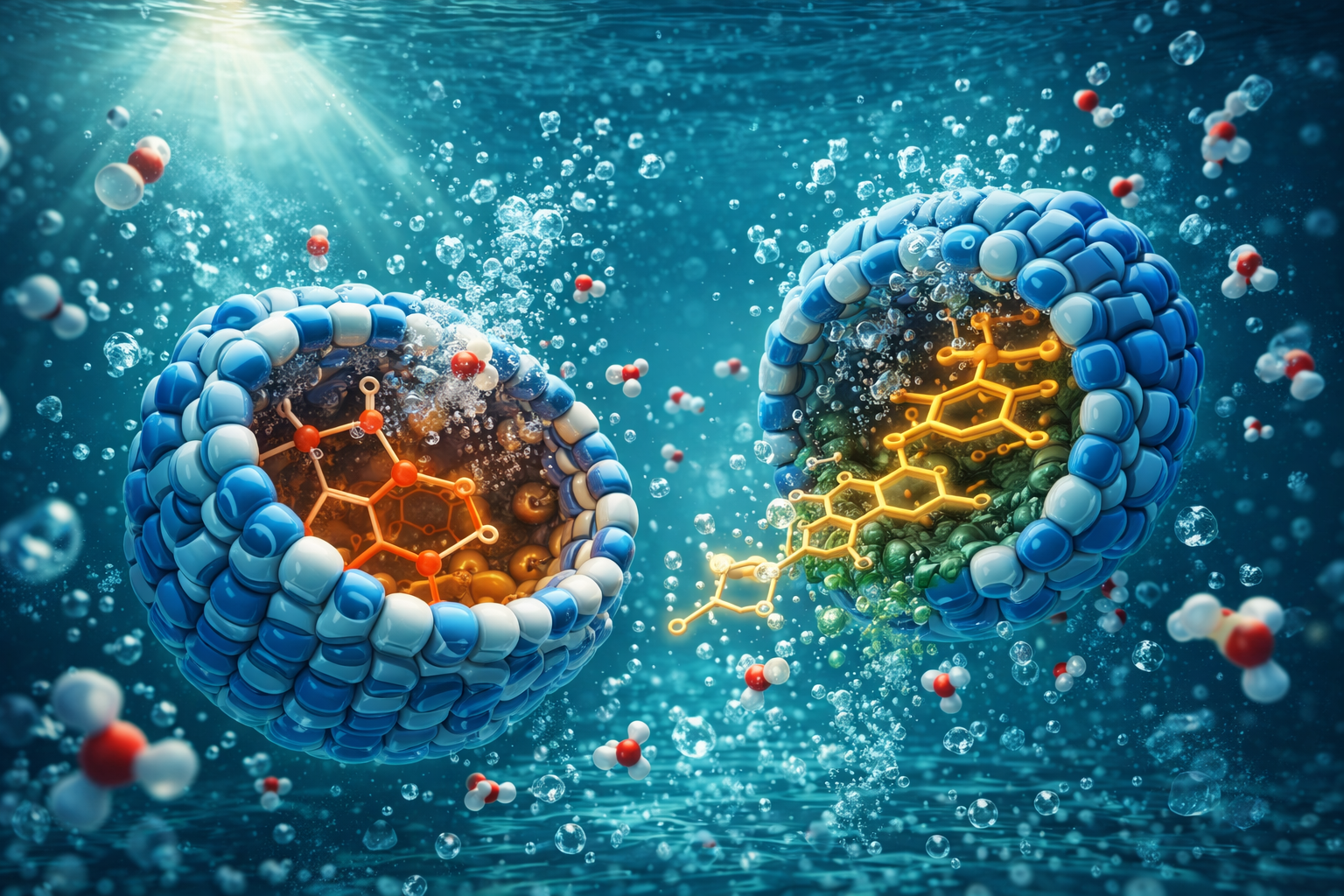
Overview graphic of the major antimicrobial mechanisms exerted by nanomaterials (figure extracted from publication)
- Membrane interaction and disruption – Adsorption, penetration, and depolarization of microbial cell walls lead to “changes in morphology, permeability, and electron transport chain inhibition”. For example, “Ag NPs adhere to the cell wall, degrade it, and increase ion passage to the cytosol”, whereas CuO and MgO NPs act through electrostatic adherence and pore penetration.
- Ion release – The liberation of Ag⁺, Cu⁺/Cu²⁺, or Zn²⁺ ions induces intracellular interactions with proteins and nucleic acids, disrupting enzymatic activity and leading to oxidative stress. The authors note that “higher concentrations of NPs release more ions, and this effect increases over time”, which can impair respiration and DNA replication.
- Reactive oxygen species (ROS) generation – Considered “one of the most important antimicrobial mechanisms of engineered nanomaterials”, ROS—including superoxide radicals (O₂⁻), hydroxyl radicals (·OH), and hydrogen peroxide (H₂O₂)—cause oxidative damage to lipids, proteins, and nucleic acids. “ZnO NPs generate three types of ROS… while CuO NPs can generate all four,” resulting in species-dependent toxicity. Light exposure amplifies this effect through photocatalytic activation, particularly for TiO₂ and ZnO.
The review extensively documents standardised assays for measuring antimicrobial performance (Fig. 3, Table 2 in the publication). The disk- and well-diffusion methods visualise inhibition zones, while broth dilution, time-kill kinetics, and plaque assays provide quantitative endpoints such as minimum inhibitory concentration (MIC) and minimum bactericidal concentration (MBC). The authors emphasise that “as of writing this article, there were no nanomaterial-specific state-of-the-art assays tailored to antimicrobial testing methods”, urging methodological refinement and harmonisation. Complementarily, computational modelling – via machine learning (ML) and in silico predictive tools – emerges as a critical design accelerator. “Machine learning techniques, such as Extremely Random Trees and XGBoosting, are frequently employed to predict factors like the dose–time dependency of antimicrobial effectiveness”. However, data scarcity and inconsistent physicochemical reporting hinder progress, reinforcing the necessity of FAIR data.
One of the paper’s defining contributions lies in integrating sustainability-by-design and circularity metrics into nanomaterial innovation. For the first time, “nano-scaled advanced materials produced by green synthesis methods are discussed with respect to their gain in sustainability and circularity”. The authors align their discussion with the Advanced Materials Initiative 2030/IAM-I and the European Commission’s Safe-and-Sustainable-by-Design (SSbD) framework, advocating for renewable feedstocks, energy-efficient synthesis, and reduced critical raw material use.
They argue that “circularity measures demand greener synthesis methods for nanomaterials, paving the way towards improved safety, optimised energy consumption, and better environmental footprint”. This section pioneers the conceptual integration of life-cycle thinking into antimicrobial nanomaterial design – an essential advancement toward regulatory acceptance and eco-innovation.
Punz et al. deliver a comprehensive synthesis bridging mechanistic, methodological, and sustainability perspectives. Their originality lies in the systematic unification of mechanistic evidence with predictive modeling and SSbD principles, creating a transdisciplinary foundation for responsible nanomaterial design. By combining “mechanistic insight, functional performance measures, and potential towards sustainability and circularity”, the review situates nano-scaled materials as a cornerstone technology in the global fight against AMR and in advancing circular, data-driven materials science.
Follow this link to read the full publication.
Parts of the research of this work (PLUS with Benjamin Punz, Constantin Christ, Alrun Waldl, Su Lli, Yingnan Liu, Litty Johnson, Vanessa Auer, and Martin Himly) has been funded by the European Union`s R&I project PINK (grant agreement # 101137809).