Penny Nymark from PINK partner Karolinska Institute (KI) was co-authoring in the following publication:
Achilleas Karakoltzidis, Chiara Laura Battistelli, Cecilia Bossa, Evert A. Bouman, Irantzu Garmendia Aguirre, Ivo Iavicoli, Maryam Zare Jeddi, Spyros Karakitsios, Veruscka Leso, Magnus Løfstedt, Barbara Magagna, Lya G. Soeteman-Hernández, Denis Sarigiannis, Erik Schultes, Vrishali Subramanian and Penny Nymark; The FAIR principles as a key enabler to operationalize safe and sustainable by design approaches; RSC Sustainability, 2024, 2, 3464; https://doi.org/10.1039/d4su00171k
The PINK project aligns closely with its key themes, particularly in integrating FAIR (Findability, Accessibility, Interoperability, and Reusability) principles into Safe and Sustainable-by-Design (SSbD) approaches. PINK supports digitalization and data interoperability by developing FAIR-compliant risk governance tools, ensuring nanomaterial data is accessible and reusable across regulatory and research platforms. It also advances New Approach Methodologies (NAMs), including in silico models and AI-driven toxicology, to enhance risk assessment while reducing animal testing. By establishing automated data quality validation and uncertainty assessments, PINK contributes to transparency and trust in decision-making. Furthermore, it aids in the seamless integration of SSbD tools through federated data-sharing models and standardized APIs. Finally, PINK strengthens cross-industry collaboration by incorporating life-cycle assessment (LCA) methodologies into (nano)material evaluations, ensuring a balanced approach to safety and sustainability.
The publication explores the integration of FAIR principles within the SSbD framework. Rooted in the European Green Deal and the Chemicals Strategy for Sustainability, the study emphasizes the necessity of data-driven assessments in designing safe and environmentally sustainable chemicals, materials, and products. Its main objective is to demonstrate how FAIR principles facilitate efficient data management, support digitalization, and enhance transparency and trust in SSbD processes. Additionally, it examines how structured, interoperable data management can harmonize SSbD implementation across industries.
Key findings highlight the role of FAIR principles in various aspects of SSbD. The study discusses how digitalization enables machine-actionable data, facilitating automated retrieval, integration, and reuse. This improves research and innovation efficiency by leveraging artificial intelligence, the Internet of Things, and other digital tools. It also underscores the fragmented nature of existing data repositories, advocating for structured metadata and standardized formats to enhance interoperability, reduce duplication, and improve accessibility.
A key example presented is the European Partnership for the Assessment of Risks from Chemicals (PARC) project, which demonstrates how digital infrastructures and harmonized metadata schemas improve the quality and usability of chemical risk assessment data. Ensuring data interoperability allows researchers to access broader toxicity and exposure datasets, minimizing repetitive laboratory testing. The study also references FAIR-enabled NAMs, such as high-throughput screening and computational toxicology models, which predict chemical hazards. One example highlights the use of in silico models to assess the toxicity of newly designed polymers, significantly accelerating evaluations while maintaining regulatory reliability.
The publication further emphasizes the significance of NAMs, including in vitro, in silico, and AI-driven modeling, as alternatives to traditional animal testing in chemical risk assessment. It argues that NAMs’ reliability and regulatory acceptance depend on implementing FAIR principles, which enhance data quality, accessibility, and usability. Another example illustrates the integration of FAIR digital tools within SSbD to assess the life-cycle impact of materials. The study describes how interoperable LCA tools improved the evaluation of biodegradable packaging, enabling comparisons of environmental impacts across production and disposal stages.
Five key areas are identified where SSbD benefits from FAIR principles. First, digitalization drives innovation by ensuring research and industrial advancements are supported by structured, accessible data. Second, interoperability across data sources is critical, as many repositories lack compatibility; FAIR adoption facilitates integration across sectors for comprehensive sustainability assessments. Third, leveraging new scientific developments, particularly NAMs, is enhanced by structured and accessible FAIR data, improving reliability and regulatory acceptance. Fourth, transparency and trust in automated assessment processes are strengthened through standardized data quality and uncertainty evaluations. Finally, seamless SSbD tool integration relies on machine-actionable data and standardized application programming interfaces (APIs) to achieve interoperability. An example of this is the federated data-sharing model in nanomaterial safety assessments, where linking diverse databases enabled more holistic evaluations of environmental and human health impacts. Transparency and trust emerge as fundamental aspects of SSbD, with the FAIR framework ensuring standardized data quality and uncertainty assessments. This fosters confidence in SSbD evaluations and decision-making. The study highlights the development of automated data quality scoring methods using AI-based algorithms to rank datasets based on completeness, relevance, and reproducibility, helping decision-makers prioritize high-quality information.
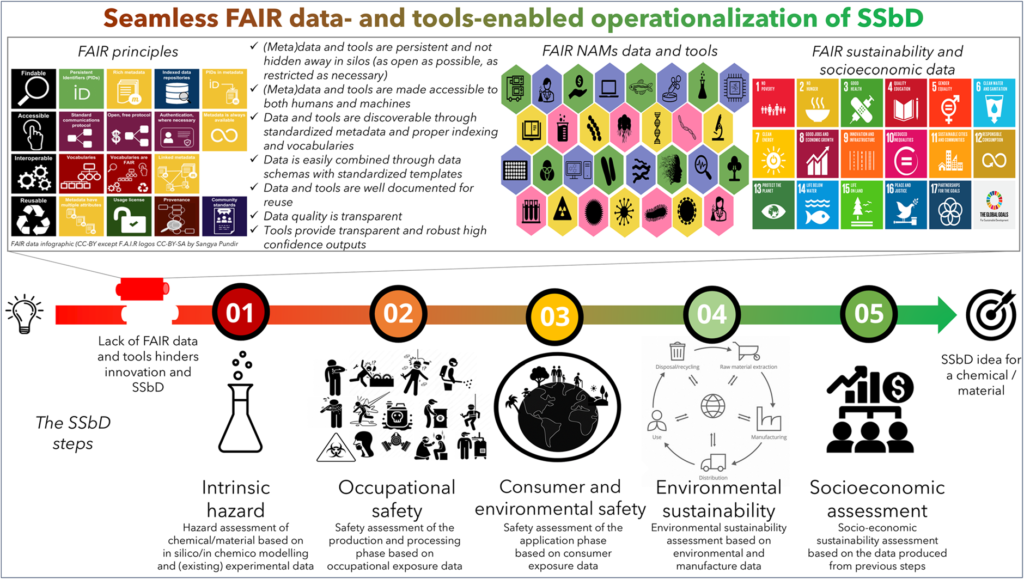
Depiction of the support that the FAIR principles (upper left) provide during R&I (the early ideation stage is used as an example). The SSbD approach is delineated at the bottom in line with the five steps of the JRC developed framework (taken from the publication)
Seamless data and tool integration is crucial for operationalizing SSbD. The study suggests that machine-readable data formats and standardized APIs enable more comprehensive sustainability assessments. A successful example is the federated data-sharing model in nanomaterial assessment, where linking diverse databases containing physicochemical properties, exposure scenarios, and toxicity endpoints improved the understanding of advanced materials’ safety and sustainability.
The publication concludes with recommendations for refining and implementing FAIR principles within SSbD approaches. It calls for domain-specific metadata standards and persistent identifiers to improve data findability and accessibility. It also advocates for clear agreements on data openness and access restrictions to balance transparency with confidentiality and regulatory requirements. Furthermore, developing and adopting controlled vocabularies and ontologies is essential to enhancing interoperability across industries and research domains. Standardized licensing policies are recommended to facilitate data reuse while maintaining provenance tracking.
To advance SSbD, the publication encourages cross-industry collaboration to integrate sustainability data with safety and functionality assessments. By embedding FAIR principles into SSbD processes, the study argues that industrial innovation can transition toward greater sustainability and transparency, supporting the European Commission’s environmental and economic objectives. It ultimately emphasizes that without structured and interoperable data, achieving genuinely safe and sustainable chemicals, materials, and products will be challenging. The examples provided demonstrate the tangible benefits of FAIR principles in accelerating innovation, improving decision-making, and fostering a culture of transparency and trust across scientific and industrial communities.
Follow this link to read the full publication.
Parts of the research of this work (Penny Nymark) has been funded by the European Union`s R&I project PINK (grant agreement # 101137809).