Scientists (Dimitris Mintis, Antreas Afantitis, and Panagiotis Kolokathis) from the PINK project partner Nova Mechanics Ltd. (NOVA), were lead- and co-authoring in the following publication:
Mintis, D. G.; Dompé, M.; Kolokathis, P. D.; van der Gucht, J.; Afantitis, A.; Mavrantzas, V. G. (2025). “Effect of pH, Temperature, Molecular Weight and Salt Concentration on the Structure and Hydration of Short Poly(N,N-dimethylaminoethyl methacrylate) Chains in Dilute Aqueous Solutions: A Combined Experimental and Molecular Dynamics Study.” Polymers, 17(16), 2189. https://doi.org/10.3390/polym17162189
This study presents a comprehensive molecular-level and experimental investigation of poly(N,N-dimethylaminoethyl methacrylate) (PDMAEMA) in dilute aqueous solution, focusing on how pH, temperature, molecular weight, and salt concentration govern its conformation, hydration, and aggregation behavior. As stated by the authors, “we study the microstructural properties and state of hydration of aqueous low-molecular-weight PDMAEMA solutions… by means of detailed atomistic Molecular Dynamics (MD) simulations and experiments”. The work combines long all-atom MD simulations exceeding 250 ns with viscosity and phase-behavior experiments, achieving a level of temporal and molecular resolution previously unattained for this class of weak polyelectrolytes.
PDMAEMA is a “smart” or “responsive” polymer that undergoes coil–globule conformational transitions driven by external stimuli such as temperature or pH. Its “large reversible conformational changes with temperature and pH” make it a model system for biomedical and nanotechnological applications, including drug delivery and gene transfection. The polymer exhibits low critical solution temperature (LCST) behavior, but its pH sensitivity adds complexity: “at acidic pH, the PDMAEMA chain is heavily positively charged, whereas at basic pH it remains uncharged”, leading to “much higher LCSTs at acidic pH”.
Previous computational works on PDMAEMA used short MD trajectories (30–50 ns) and focused on single 30-mer chains, often producing inconsistent results. Mintis et al. therefore aimed to “perform very long all-atom MD simulations, exceeding 250 ns, for PDMAEMA solutions with molecular lengths ranging from 30 to 110 monomers” and to “conduct experiments to support and validate the simulation results”.
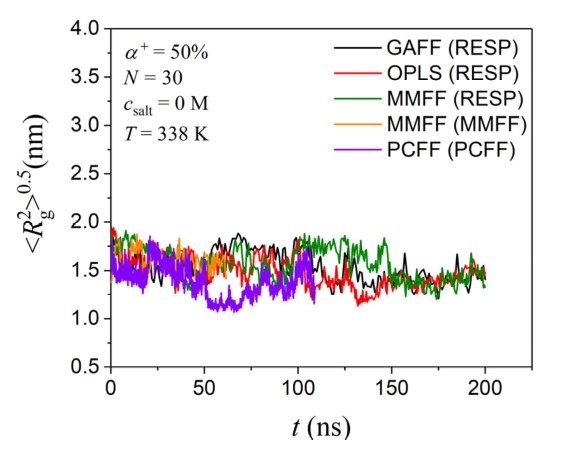
Time evolution of the radius of gyration of an alternately protonated 30 mer long PDMAEMA chain at 338 K and a 0 M salt concentration from the present simulations with all different force fields (GAFF, OPLS, MMFF, and PCFF).
Two PDMAEMA samples were characterised experimentally (Mn = 5.5 and 19.0 kg mol⁻¹), and viscosities were measured between 20 °C and 50 °C. Parallel MD simulations explored chain lengths (N = 30–110), temperatures (277–370 K), ionic strengths (0 and 1 M NaCl), and ionization states (0 %, 50 %, 100 %). All systems were modeled using the GAFF force field with RESP charges and the SPC/E water model. Protonation states were fixed to represent “fully protonated, alternately protonated, and fully deprotonated” chains, corresponding to acidic, neutral, and basic pH conditions.
Each system underwent multi-hundred-nanosecond nPT simulations under periodic boundary conditions. The long timescales ensured equilibration and allowed precise evaluation of radius of gyration (Rg), hydrogen bonding statistics, solvent-accessible surface area (SASA), and pair distribution functions g(r).
(a) Temperature and Chain-Length Effects
MD simulations showed that short, unprotonated PDMAEMA chains (N = 30) exhibit “no appreciable conformational changes with temperature”. The radius of gyration remained constant (≈ 16 Å) across 277–370 K, in agreement with viscosity data showing that “the hydrodynamic radius, Rh, does not change dramatically with temperature”. For longer chains (N = 50–110), minor decreases of 2–4 Å in Rg occurred with heating, implying that the coil-to-globule transition is suppressed in short chains due to “high inherent rigidity” and low conformational entropy.
The scaling relation ⟨Rg²⟩¹ᐟ² ∼ N^ν yielded ν ≈ 0.56 (283 K) and 0.50 (338 K), indicating “nearly ideal random-coil behavior below and above the LCST” (p. 11). Thus, PDMAEMA remains swollen even above LCST – unlike poly(acrylic acid) or poly(ethylene imine) – due to its “longer and more flexible side chain containing an ester and a dimethylamino group”.
(b) Salt Effects
The simulations revealed that Na⁺ ions interact strongly with the oxygen atoms of the PDMAEMA side chains, while Cl⁻ anions show minimal binding: “Na⁺ salt ions strongly interact with the oxygen atoms located at the side chain of the polyelectrolyte”. Salt shortened hydrogen-bond lifetimes (τ_BF ≈ 5 ps at 338 K) and modestly decreased Rg for long chains, but “no drastic changes to the overall shape of the polymer” were found.
(c) Aggregation Behavior
In semi-dilute systems, aggregation increased with both temperature and salt concentration. The authors report “strong temperature- and ionic-strength-dependent aggregation characteristics” (p. 15), consistent with hydrophobic collapse and screening of electrostatic repulsions.
(d) pH and Ionisation
A pronounced structural transition emerged when varying the degree of protonation. Increasing ionisation (from 0 % to 100 %) led to a shift “from a highly collapsed to a stretched conformation”, as evidenced by simultaneous increases in radius of gyration and persistence length (Lp). This reflects enhanced intrachain electrostatic repulsion and stronger hydration: “Fully charged PDMAEMA chains were found to be highly soluble, while unprotonated chains were highly hydrophobic”.
The study reconciles inconsistencies in prior literature by demonstrating that short PDMAEMA chains lack a true LCST transition, and that only longer or aggregated systems exhibit thermo-responsive behavior. The combined simulations and experiments reveal that temperature alone does not drive conformational collapse unless augmented by ionic effects or partial protonation.
This work’s originality lies in its integration of extensive atomistic MD with experimental validation, establishing reliable molecular descriptors (Rg, Lp, H-bond dynamics) for PDMAEMA. The authors conclude that “no changes take place in the local rigidity, global shape, and hydration of short PDMAEMA chains… due to their highly hydrophobic nature”, while “a strong dependence on pH and salt concentration emerges in more concentrated solutions”.
Follow this link to read the full publication.
Parts of the research of this work (NovaMechanics) has been funded by the European Union`s R&I project PINK (grant agreement # 101137809).